AI & Web••8 min read

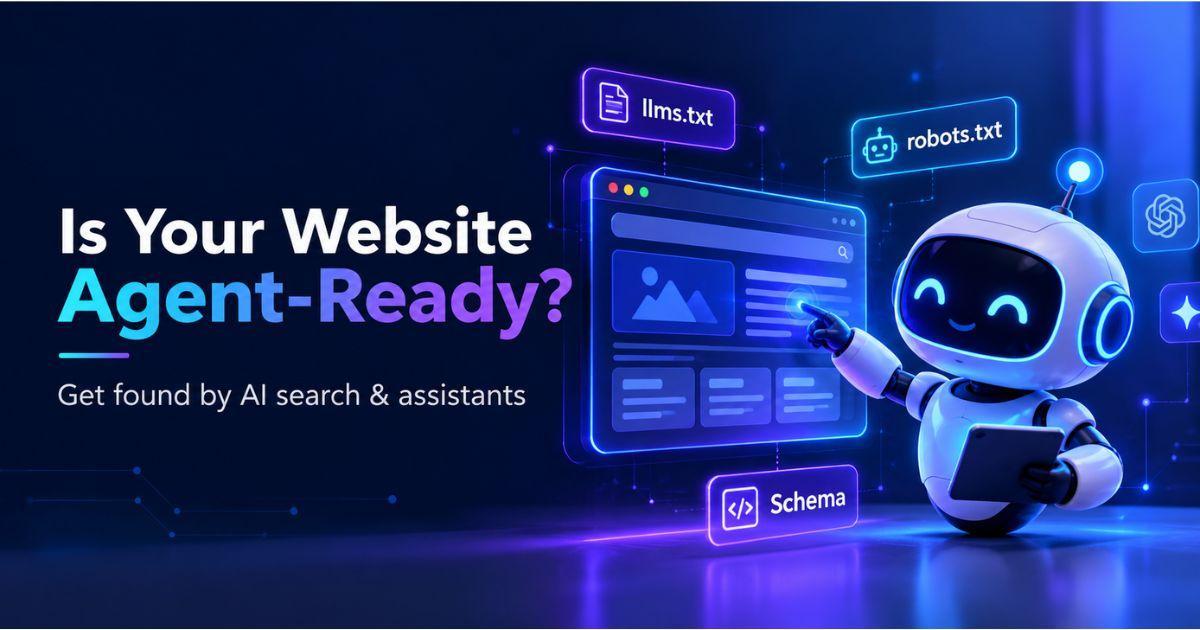
Is Your Website Agent-Ready? A 2026 Guide

An agent-ready website is one that AI systems can easily discover, read, and act on. This guide explains what it means and provides an actionable checklist.

EC

Exelon Circuits Team

AI & Web Architecture Lead
Is Your Website Agent-Ready? A 2026 Guide

1. What Is an AI Agent & What Does 'Agent-Ready' Mean?

Your next website visitor may not be a person. AI agents now research products, compare prices, book services and request quotes on behalf of the people who use them. If an agent cannot find or understand your site, it will skip you or get your details wrong.

An AI agent is software that browses, queries and completes tasks for a user without that user visiting each page. Examples include AI assistants that shortlist suppliers, compare service providers or fill in an enquiry form.

Agents read your site differently from people. They do not look at your visual design; they read your HTML, structured data, and the contextual files around your site that explain what you offer.

A website is agent-ready when it gives AI systems three things:

1
Permission — Clear rules on which AI crawlers may access which content.
2
Understanding — Clean, structured content that a machine can read without guessing.
3
Action — Where it makes sense, a way for agents to request a quote, book or buy.
Key Architectural Takeaways
  • Just as being mobile-friendly became essential a decade ago, businesses that prepare for AI agents early will get found first.
  • AI assistants evaluate clear data, clean code, and plain text rather than visual layouts.

2. The 6 Building Blocks of an Agent-Ready Website

1
An AI-Aware robots.txt — Your robots.txt file controls which automated web crawlers can access your pages. Many websites accidentally block AI search systems through default hosting or CDN firewall rules, rendering them invisible to AI assistants. To ensure your business gets found, configure your robots.txt deliberately to allow reputable AI crawlers (such as GPTBot, ClaudeBot, PerplexityBot, and Google-Extended) while pointing them directly to your XML sitemap.
2
An llms.txt File — Hosted directly at your site root (example.com/llms.txt), llms.txt is a plain-text Markdown document introduced as an open standard in late 2024. It acts as an executive summary for AI models: outlining who you are, what services and products you provide, and where to find key resources like case studies and contact forms.
3
A Complete sitemap.xml — A comprehensive sitemap lists every page you want discovered and indexed. Keep it updated automatically and reference its URL explicitly inside your robots.txt file so crawlers always know where to find fresh content.
4
Structured Data (Schema.org) — Schema markup tells machines exactly what your content represents: an Organization, a LocalBusiness, a Service, a Product, or an FAQPage. Adding structured JSON-LD data eliminates ambiguity and helps your business win rich results across both traditional search engines and AI answer engines.
5
Clean, Semantic HTML — Structure your pages using proper heading hierarchy (a single H1 per page, followed by logical H2 and H3 elements), descriptive link text, and alt text on images. Avoid hiding essential information behind heavy client-side JavaScript, which can prevent AI crawlers from reading your content reliably.
6
An API or MCP Server (When Needed) — If customers need to check live pricing, stock availability, or order status through AI assistants, publish a documented API with an OpenAPI specification. The Model Context Protocol (MCP) is an emerging open standard that connects AI assistants to external tools and live data, but you only need it when there is a clear, dynamic use case.
Key Architectural Takeaways
  • Allow reputable AI crawlers in your robots.txt file and add a simple llms.txt summary at your website root.
  • Use structured Schema.org data and clean HTML so AI assistants can understand and cite your services accurately.

3. Why Agent Readiness Matters & Who Benefits Most

Why Agent Readiness Matters for Your Business:

Visibility in AI search — Assistants can find, recommend, and cite you accurately.
Fewer errors — Structured content reduces the chance that agents misstate your services or prices.
New lead channel — Agents shortlisting suppliers for a buyer can reach your enquiry page directly.
Control — You decide which bots see what.
Early-mover advantage — Most small and mid-sized business websites in India have not taken these steps yet.

Who Benefits Most:

E-commerce stores — Product search, comparison, and checkout.
SaaS and software companies — Documentation, pricing, and API access.
Travel and hospitality — Availability and booking.
Local service businesses — Quotes, appointments, and contact details.
B2B companies — Being shortlisted when agents research suppliers.

4. The 10-Point Agent-Readiness Checklist

Follow this practical audit checklist to verify your web assets:

1
robots.txt allows desired AI crawlers and references your sitemap.
2
llms.txt is published and maintained at your site root.
3
sitemap.xml is complete, valid, and automatically updated.
4
Organization, LocalBusiness, and Service schemas are configured.
5
FAQPage schema is active on key informative landing pages.
6
Single H1 per page with logical heading hierarchy and descriptive image alt text.
7
Core content is visible in clean HTML without heavy JavaScript blockers.
8
Contact and request-a-quote pages are easy to find and simple to submit.
9
Any public or customer-facing APIs are clearly documented using standard OpenAPI specifications.
10
Quarterly reviews are scheduled to adapt as emerging agent standards evolve.
Key Architectural Takeaways
  • Review your crawler settings, structured data, and website summary files every few months as AI standards evolve.
  • Preparing for AI search also directly boosts your regular Google rankings, page loading speed, and user experience.

Be Realistic About Results

Agent standards are still evolving, and different AI systems read different signals. These steps will not transform traffic overnight. They are low-cost preparation that also improves your traditional SEO, accessibility and site quality.

5. Frequently Asked Questions

Technical Assessment

Get a Free Agent-Readiness Audit

Exelon Circuits builds fast, SEO-friendly websites and helps businesses in Mangaluru, Udupi and across India get ready for AI-driven search. We inspect your robots.txt, llms.txt, structured data and site architecture, then provide a prioritised fix list.

Related Topics
AI AgentsAgent-Readyllms.txtSchema.orgWeb ArchitectureSEOOpenAPIMCP